Autonomous software developmentFocus on what matters
Ship on time
Most teams bought Copilot, Cursor, Claude Code or Codex and got a few faster developers. We install a full autonomous development loop that carries every ticket to a reviewed pull request inside your own pipeline. That is a change to the process, not to the editor.
You bought an AI tool. The development process never changed.
A faster autocomplete makes a few developers quicker at typing. The software development pipeline itself, spec, review, tests, deploy and the waiting in between, works exactly as it did before. That is where the time goes.
AI in the editor
Agents in the pipeline
Think, act, check: an autonomous development loop at every stage.
Each agent runs the same loop of decide, act, read the result, repeat. The pipeline it plugs into changes with the work. Below, a feature and a bug go from ticket to merged pull request.
You see every run, priced to the line.
Agents that work unattended are only worth having if you can check them afterwards. Every ticket the loop touches lands here with its time, its tokens and its cost, so the question stops being “is this working?” and becomes “what does a shipped change cost us now?”
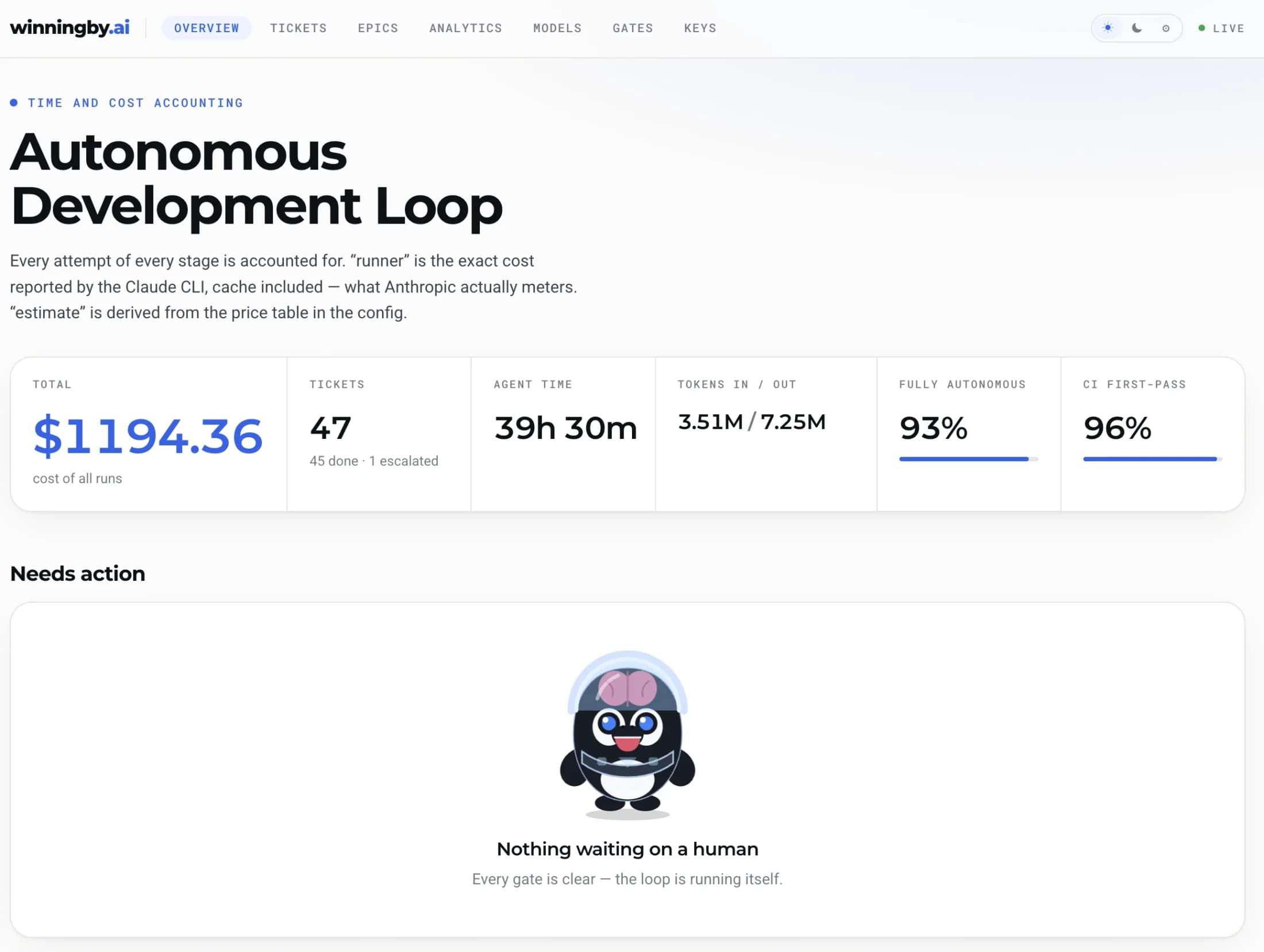
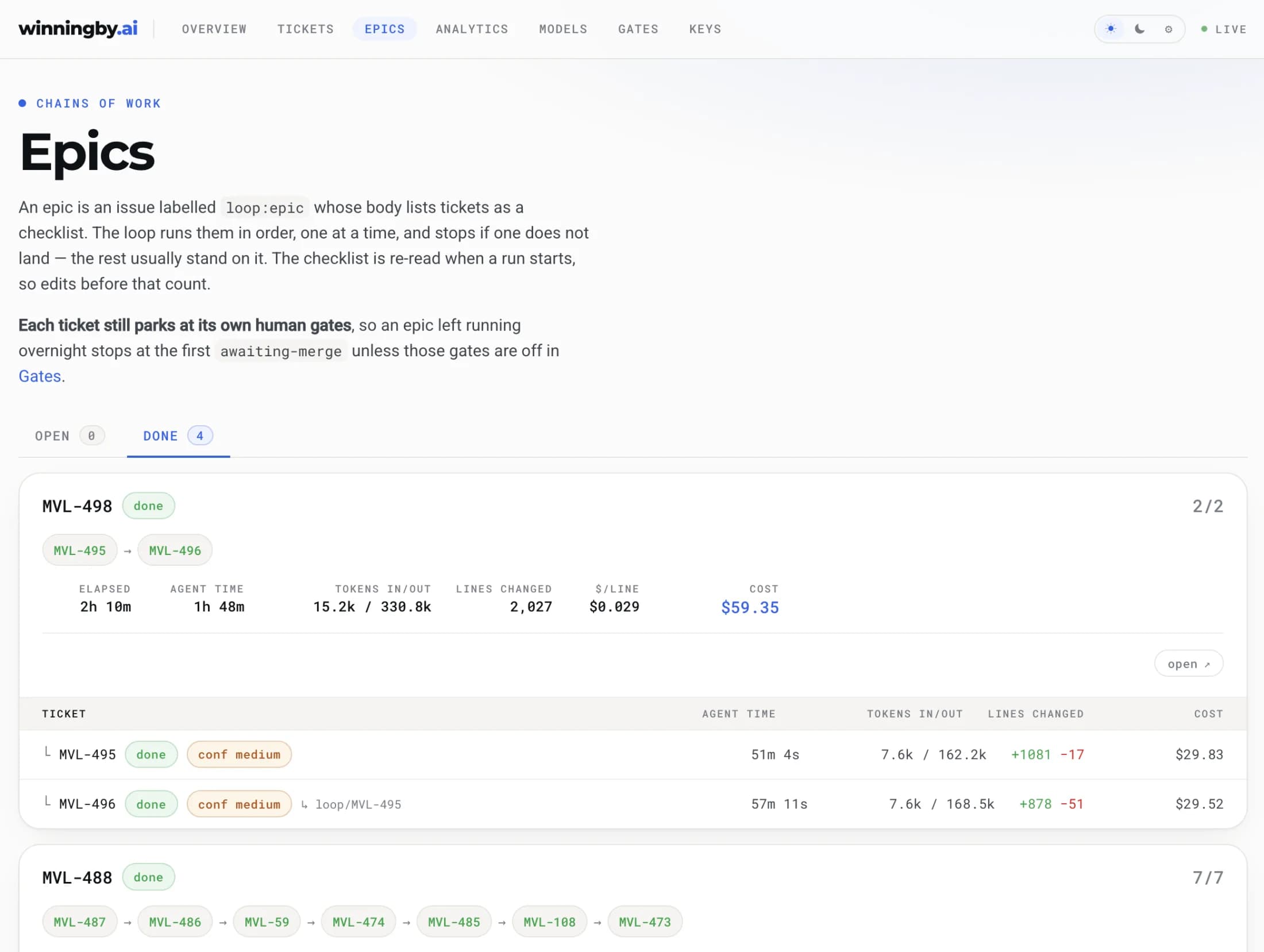
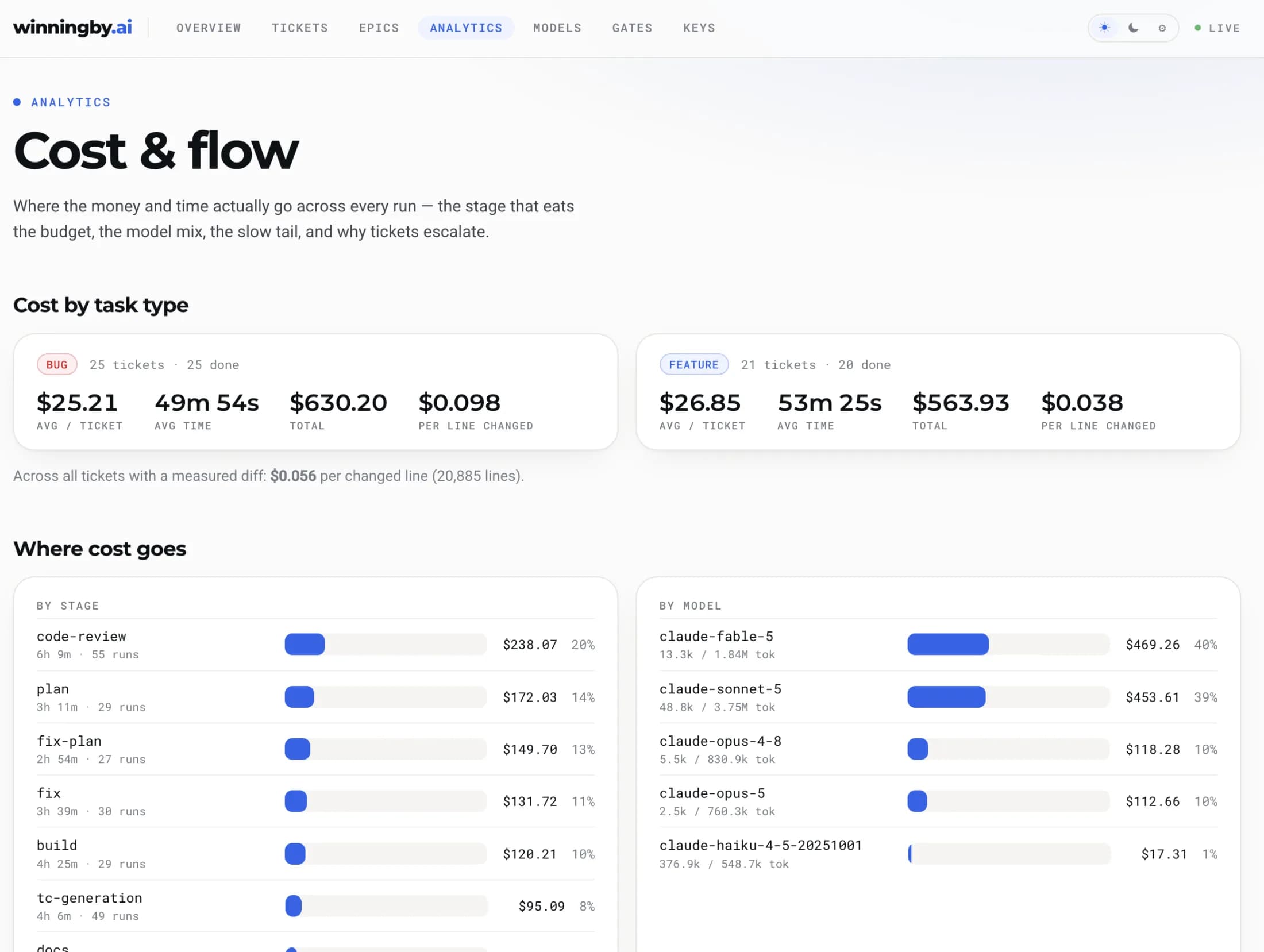
What the whole thing cost. Every attempt of every stage is accounted for. Cost comes from what the model provider meters, cache included, so it is not an estimate. Next to it sit the two numbers that decide whether the loop is working: how often it finishes on its own, and how often CI passes first try.
AI writes the code. A developer prompts another AI to review it. Slop still reaches prod.
The review turns into prompt ping-pong. Someone types a prompt, waits, skims a wall of generic findings, pastes the useful ones back, waits again. The hours go into driving the tool, and the questions that need a human (does this solve the problem, what does it cost us in six months) never get asked.
Every arrow is a person waiting on a chat window. Attention runs out long before the deep questions start, so the diff gets approved on vibes.
Anything a machine can check (the spec, the tests, your conventions, the obvious security holes) is handed to the machine completely, and the agent fixes what the review finds before a human is pulled in. Nobody types a review prompt. The pull request that lands on your desk has already been through a full review cycle.
Which leaves the reviewer the part only a human can do.
Does it actually solve the problem?
The reviewer reads the ticket and the diff together, instead of re-litigating naming and null checks a machine already caught.
What does it cost us in six months?
A duplicated path, a leaky abstraction, a shortcut that hardens into a house pattern. Tech debt is a judgment call, and judgment is the one thing you can’t delegate.
Where will this break?
Load, edge cases, the failure mode nobody wrote a test for. The real risk usually lives in the parts of the system that aren’t in the diff.
You set the rules. The agent can’t step outside them.
Every action is gated, scoped to the launching engineer’s own permissions, and logged. You decide how much autonomy each class of action gets, and you raise it as the agent earns your trust.
Autonomy policy
live · try itSet what each risk class is allowed to do on its own.
Ready for regulated teams
Start fully supervised. Every change waits for human approval, and your team raises the autonomy per action class instead of all at once.
Runs with your permissions
An agent uses the launching engineer’s credentials and never more. If a human can’t touch it, neither can the agent.
Sandboxed · never prod funds
Agents work in isolated environments and open pull requests. They never reach money-moving or production-fund code.
Crash-safe & fully audited
Checkpointed runs never double-execute a write on retry. Every action is logged in a complete, audit-ready trail.
Compliant by design. Hosted on your servers.
Every system we ship is built to meet GDPR, CCPA, and the EU AI Act from day one. It runs in your own infrastructure, on your servers or in your cloud, so data never leaves your environment and compliance stays fully in your hands.
GDPR
Your data never leaves your environment. Agents run on your servers, under your own access policies, and touch only what a ticket needs. Deletion and audit requests are simple to honor because every action sits in one log.
CCPA
Consumer data stays where it already lives. The loop adds no new data brokers, no third-party processors, and no shadow copies, so the CCPA posture you have today carries over unchanged.
EU AI Act
Human oversight is on by default. Every agent action is gated, logged, and reversible, and a human approves plans and merges. That maps directly to the transparency and oversight the AI Act asks for.
Two founders, in the room with you.
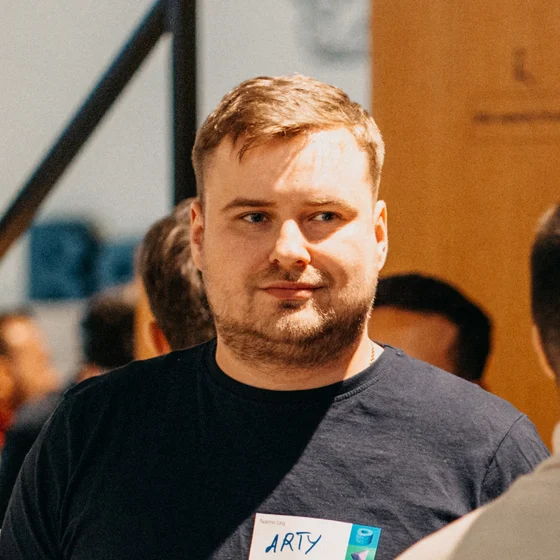
There are no account managers and no handoffs. The people who design the loop are the people who sit with your engineers.

- 9+ years building high-load systems
- 3+ years as Tech Lead and Solution Architect on enterprise delivery
- Builds autonomous AI agents, MCP servers and RAG pipelines with LangChain
- Keeps improving autonomous loops so engineering tasks finish faster and cost less
The objections you’re already thinking.
Book a 30-minute process review.
No pitch. We look at your pipeline together and you leave with improvements.